Google Ads
Three lines
decide
everything.
Your ad is three short lines of text.
Get them wrong and you pay full price for clicks that never buy. We test and keep the winners.
$6 vs $12
The same keyword can cost one company $6 and another $12. The difference is often nothing but the ad.
Better copy is not just more clicks. It is a cheaper auction.
Three lines decide everything
A Google search ad is tiny. You write a few short headlines and a couple of description lines, and Google mixes them as it serves the ad. That is all the buyer sees before they choose you or a competitor.
Those few words do more work than anything else in the campaign.
Bad copy is expensive twice:
- It earns a low click rate, Google reads it as weak, and your cost per click goes up
- The wrong people click, and you pay for visits that never become inquiries
So you lose on the price and the quality of the traffic at once. The worst place to be.
Why copy moves your price, not just your clicks
In China, many teams treat the ad text as a formality. Google does not work that way.
Google measures how often people click your ad. That number is the click-through rate, or CTR. A high CTR tells Google your ad is relevant. Relevant ads get a better Quality Score, and a better score buys a lower price for the same spot.
A Quality Score of 6+ can cut your cost per click 16 to 50%. A score of 4 or lower can raise it 25 to 400%.
B2B search ads average a CTR of roughly 3 to 6%. Top performers reach about double that.
So the same keyword can cost one company $6 and another $12. The difference is often nothing but the ad. Better copy is not just more clicks. It is a cheaper auction.
What good copy says for an exporter
A buyer in Hamburg or Chicago wants two things, fast.
First, proof you make what they need. Then a reason to trust a supplier they have never met and probably can't visit. The strongest export ads put the business signal right in the text:
Weak
"High Quality Reliable Products, Professional Service, Welcome to Inquire"
Strong
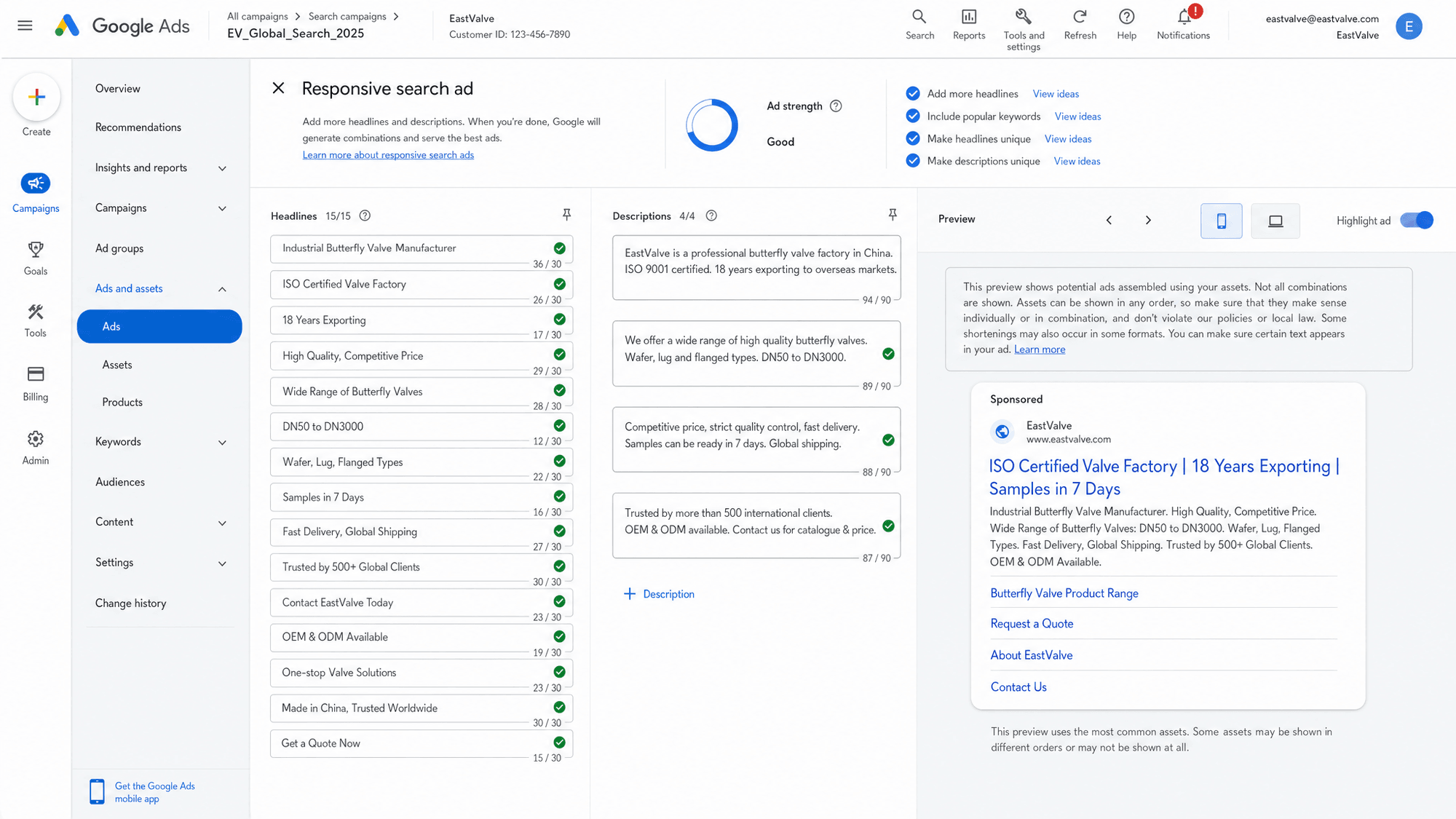
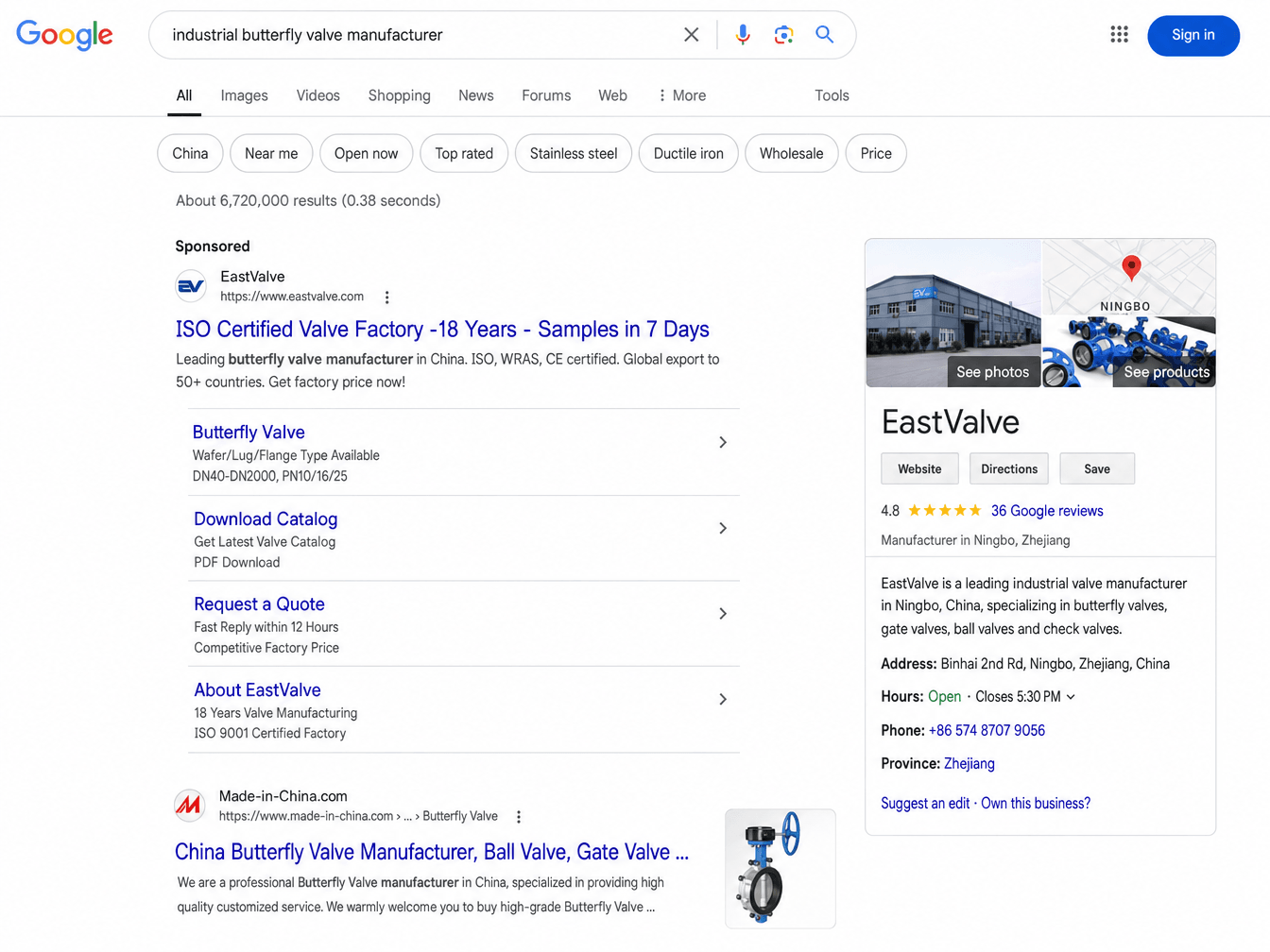
"ISO Certified Valve Factory, 18 Years, Samples in 7 Days"
The weak ad says nothing, and a buyer scrolls past. The strong ad answers a question the buyer was already asking. Specifics beat slogans. Lead with years in business, capacity, a certification Western buyers check for, or a clear promise like fast samples.
And it has to read like native English. A translated headline that sounds slightly off tells a buyer you might be hard to work with. Our team has sat on the buying side in Europe and the US, so we know which phrases build trust and which ones cost you the click without you ever noticing.
A/B testing on every ad
There is no perfect ad you can write in advance. There is only the ad that wins this week, in this market. You find it by testing.
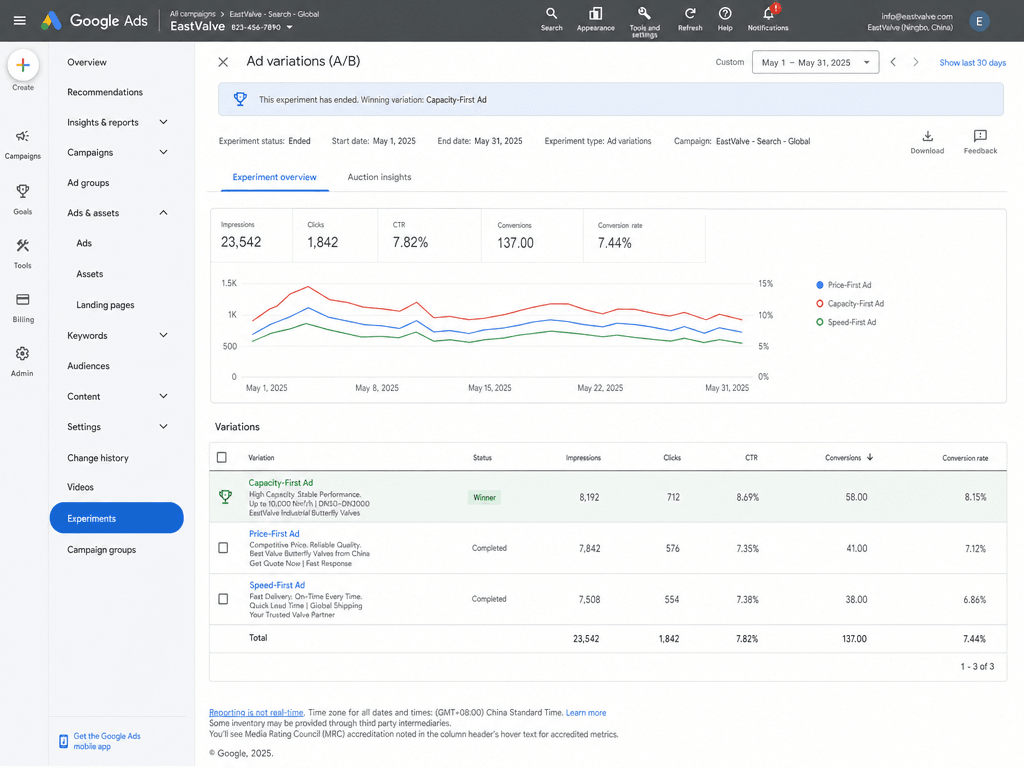
For every ad group, we run more than one version at once:
- A One leads with price
- B One leads with capacity
- C One leads with speed
Google shows them, buyers vote with their clicks, and the data picks the winner.
When ads quantify business impact instead of listing features, conversion rates rise about 40%.
A typical rhythm: launch three or four versions, give them a week or two to gather clicks, retire the weakest, write a fresh challenger against the best. You are never really finished, and that is the point.
This is the opposite of the Baidu habit, where the format is rigid and the text often sits unchanged for months. On Baidu the headline and description lengths are fixed and real split-testing is awkward. On Google the ad is a living thing.
We follow up daily
Testing is only half of it.
A test does nothing unless someone reads the results and acts. We do, every day. Google charges your card automatically, so a weak ad can drain a budget fast. We watch the click rates, the costs, and the search terms report, which shows the exact words people typed before your ad appeared.
Wrong crowd clicking? We pause the version.
A search term wasting money? We block it.
Google bills your card automatically and can run past budget, so monitor data daily and adjust in time.
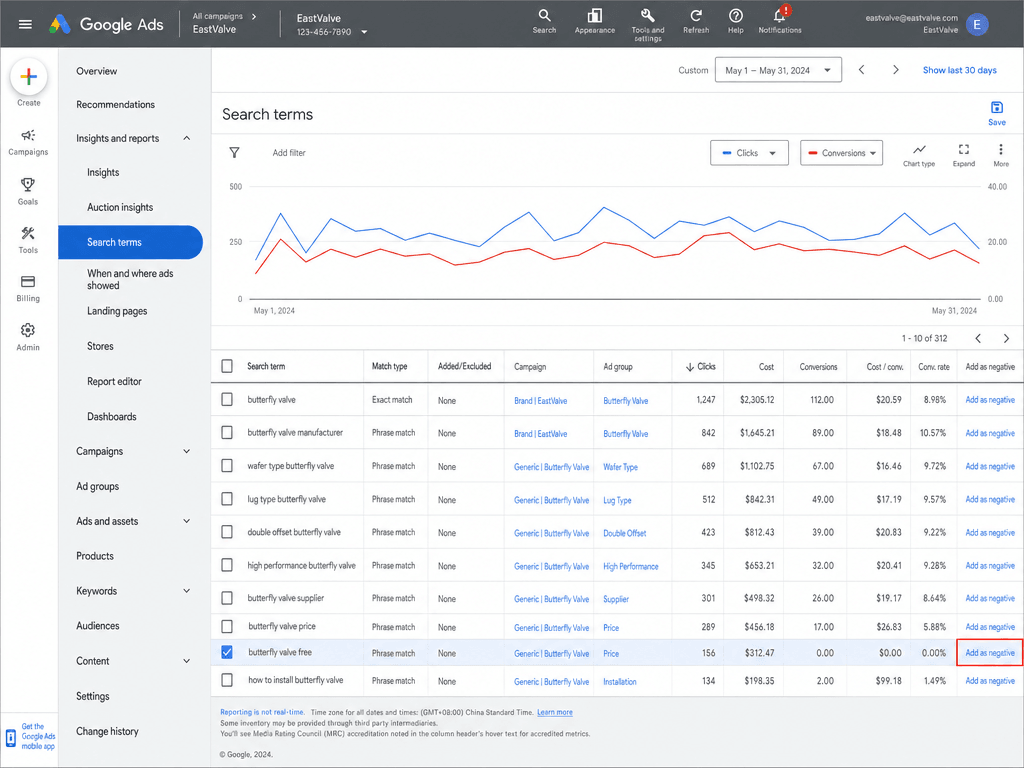 The search terms report
 The ad and the page must agree
The best ad in the world fails if the click lands on the wrong page.
If your ad says "custom stainless valves, samples in 7 days," the page must say the same thing, in the same words, at the top. We write the ad and the page together, never apart. More on that on the landing pages page.
Questions
Questions, answered plainly.
Who writes the ads, us or you?
We do, in native English. You only approve. You do not need an English copywriter or a designer on your side.
It is only three lines of text. Why does it matter so much?
Those three lines decide your click rate, and your click rate decides your price. Better copy is not just more clicks, it is a cheaper auction for the same spot.
Our English is okay. Can we write the ads ourselves?
You can, but a headline that reads slightly off tells a Western buyer you may be hard to work with. We have sat on the buying side in Europe and the US, so we know which phrases build trust.
What makes a strong export ad?
Specifics. Years in business, capacity, a certification buyers check for, or a clear promise like samples in 7 days. Slogans like "high quality, professional service" say nothing and get scrolled past.
How many ads do you run at once?
Usually three or four versions per ad group, each leading with a different angle, price, capacity, or speed. Buyers vote with their clicks and the data picks the winner.
What is A/B testing, in plain terms?
Running more than one version of an ad at the same time to see which one wins, then keeping the winner and writing a fresh challenger against it.
How often do you change the ads?
We watch them daily and refresh on a rhythm. The best ad this month may not be the best next month. On Google the ad is a living thing, not a fixed format.
Is this different from Baidu ads?
Yes. On Baidu the headline and description lengths are fixed and the text often sits unchanged for months. On Google we test and rewrite constantly.
Can we put our price in the ad?
Often yes, if it helps. We test a price-led version against capacity-led and speed-led versions and let the clicks decide what works for your market.
What is CTR?
Click-through rate, how often people click your ad after seeing it. A higher CTR tells Google your ad is relevant, which lifts your Quality Score and lowers your cost.
What is the search terms report?
A list of the exact words people typed before your ad showed. We read it daily to pause the wrong audience and block terms that waste money.
Will good ads work if our website is weak?
No. The best ad in the world fails if the click lands on the wrong page. We write the ad and the landing page together, in the same words, never apart.
Do you write in languages other than English?
We focus on native English for Western buyers. If a market needs German or another language, we handle that too, written by a native speaker, never a straight translation.
How do we know the copy is working?
We track the click rate, the cost per click, and which ad turns clicks into real inquiries, and we report it in plain numbers, not a confusing dashboard.
What does the copy work cost?
It depends on how many campaigns and markets you run, so we keep pricing to a conversation. You get a clear number before you commit.
Still have a question? Book a call and we will answer it straight.
Make every line earn its click
The right three lines, in real English.
The right three lines, in real English a Western buyer trusts, can be the difference between a click that buys and a click that bounces.
We will write them, test them, and watch them daily so your money goes to buyers, not browsers. Pricing depends on how many campaigns and markets you run, so we keep that to a conversation.
We have sat on the buying side in Europe and the US.
Reviewed June 2026
Next module: Landing pages