Skip to content
Beyond Bridge
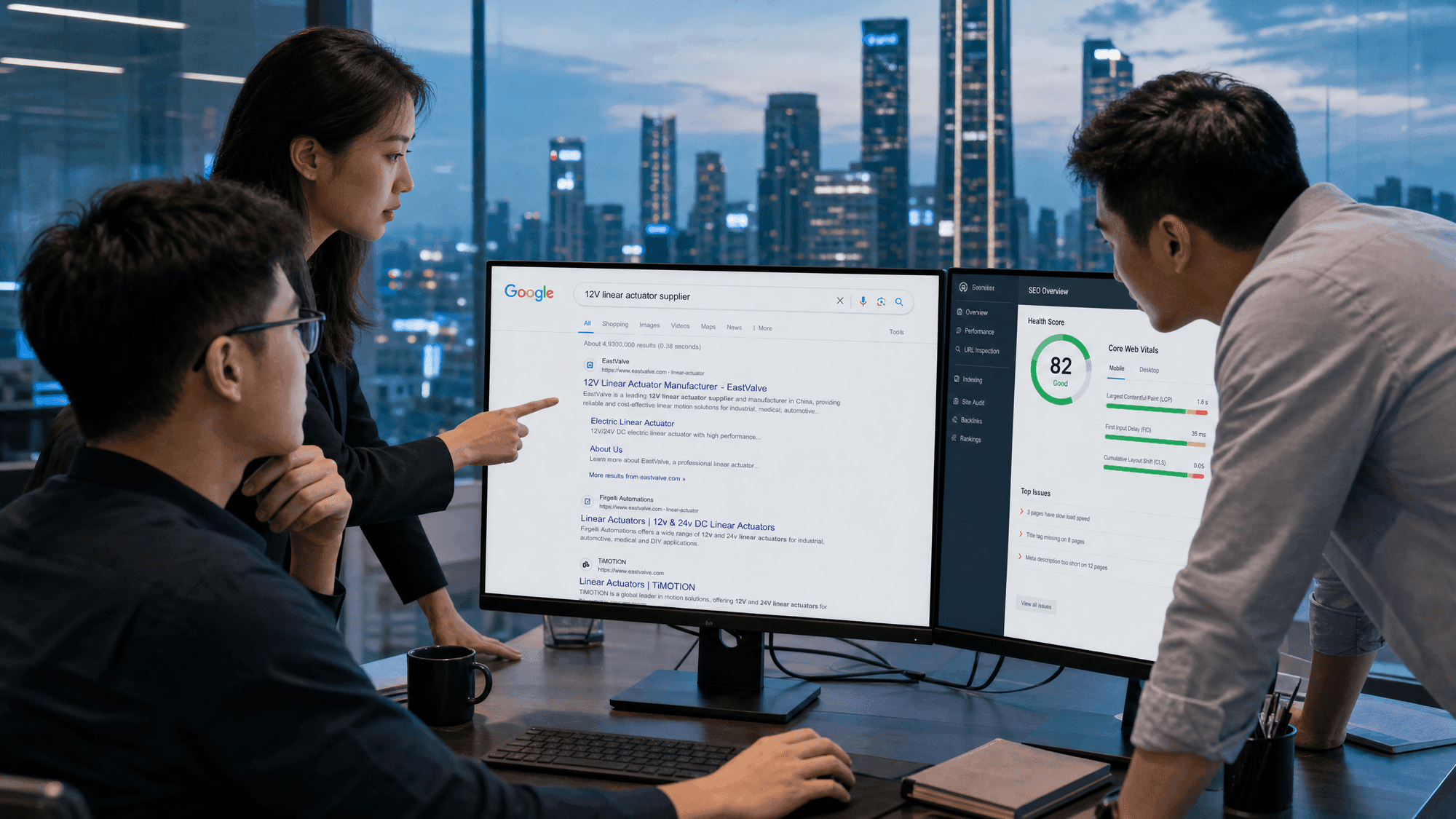
A Chinese export marketing team studying a Google search results page and an SEO audit dashboard on office monitors

The Search module

A site Google
actually trusts.

Not a Baidu site in an English coat.

Your Baidu playbook does not work on Google. We audit your site against the rules Google really uses, find what blocks your rankings overseas, and hand you a clear plan to fix it.

Where the clicks go

68.7%

of clicks go to the top three Google results. The number one spot alone takes 39.8%.

Land on page two and, for most searches, you may as well not exist.

Audit & strategy Onsite SEOOffsite SEOGEO

Why the translated site fails

Two engines. Opposite rules.

You spent years learning to win on Baidu, and overseas almost none of it carries over. Google is a different engine that plays by opposite rules, and the habits that ranked you at home can quietly sink you abroad.

At home

Baidu

Simplified Chinese, .cn domains, links from Chinese sites, servers inside China.

Baidu wants near 85% Chinese characters on a page. It favors .cn domains, links from other Chinese sites, and hosting inside China. Its crawler handles JavaScript poorly, so it leans on plain HTML. Trust grows inside the Baidu ecosystem.
Overseas

Google

Original native English, trusted Western links, fast hosting near your buyers.

Google wants original, native English. It rewards links from trusted Western sites. It wants fast hosting near your buyers, not behind the Great Firewall, where a request from New York or Frankfurt can crawl or drop. And it weighs trust in a way the home-market engine never has.

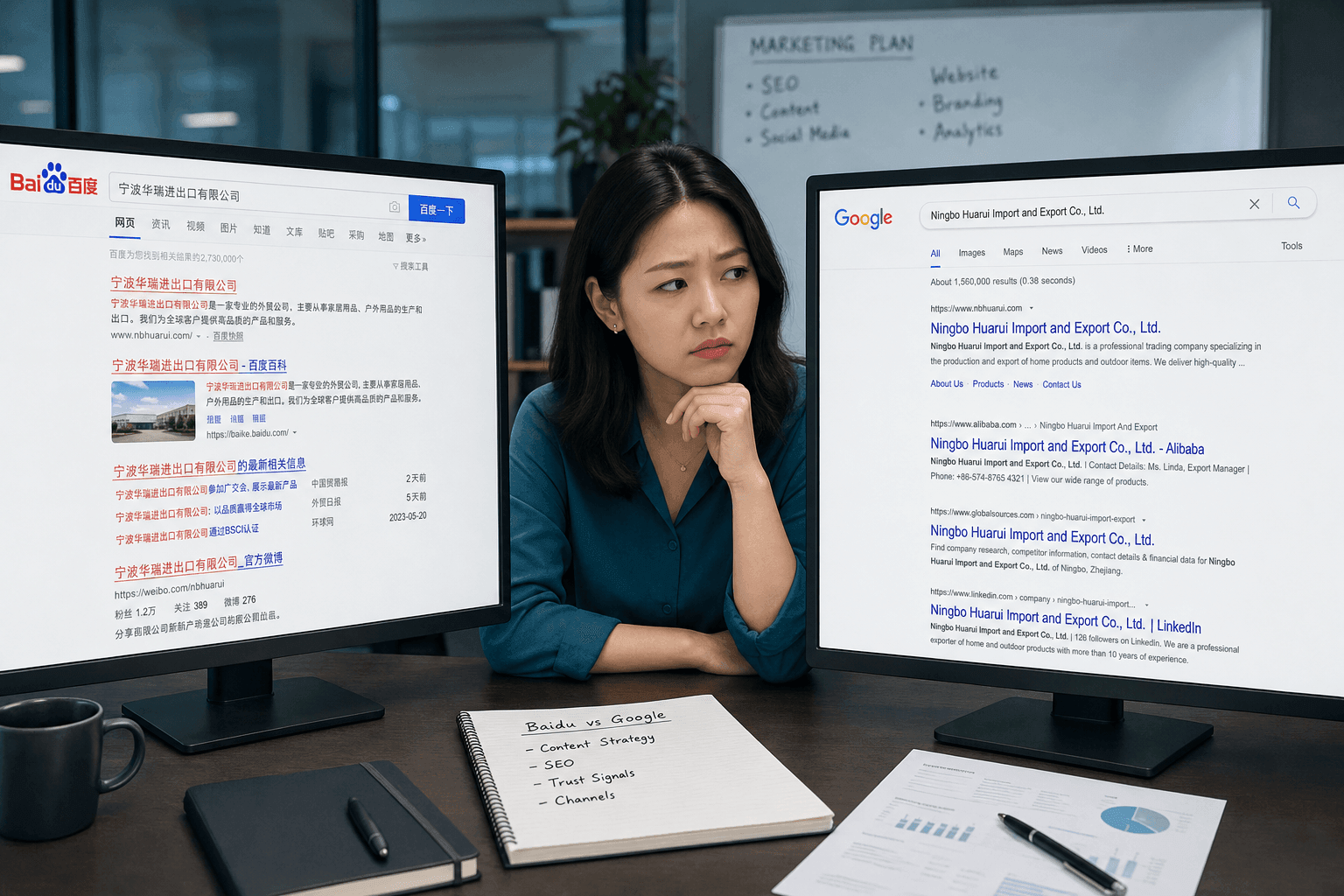
A Chinese marketer comparing a Baidu results page against a Google results page on a laptop
A Chinese site translated into English is not a site built for Google.

The pattern

The same trap, on almost every site.

We have audited well over a hundred of these sites. The failures repeat, and we can almost name them before opening the file.

The site is half-translated.

The homepage is English. Product and support pages are still Chinese, or stuck half-done for months. Google reads the mix as a poor experience and holds the whole site back. Often the old Chinese pages outrank the new English ones for your own company name, so you compete with yourself.

audit.diff
- Home EN, product pages 中文
+ Every page in native English

How Google decides who to trust

New ground for Chinese companies: EEAT.

Trust is the most important member of the EEAT family. A page that is untrustworthy has low EEAT no matter how experienced or expert it seems.
Google Search Quality Rater Guidelines, September 2025

EEAT stands for four things Google asks about every page. Experience: has the writer actually done the thing, not just read about it. Expertise: do they really know the subject. Authoritativeness: do other respected sites point to you as a source. Trust: is the page honest, accurate, and safe to act on. In plain terms, Google is asking the same question a Western buyer asks before wiring money to a supplier they have never met: who are you, how do I know, and can I believe you.

On Google that means named authors with real bios, links and mentions from outside sites, accurate facts, clear contact details, and a secure site. Baidu earns this another way, so it is new ground, and Google tells its reviewers to flag faked authors and invented expertise.

Months before most sites see real movement. EEAT is a slow build, and some deeper authority signals take a year or more to land. We say this on the first call. Anyone promising faster is selling something.

What we audit

A full check against Google’s current best practices, in three layers, with every issue weighed by impact.

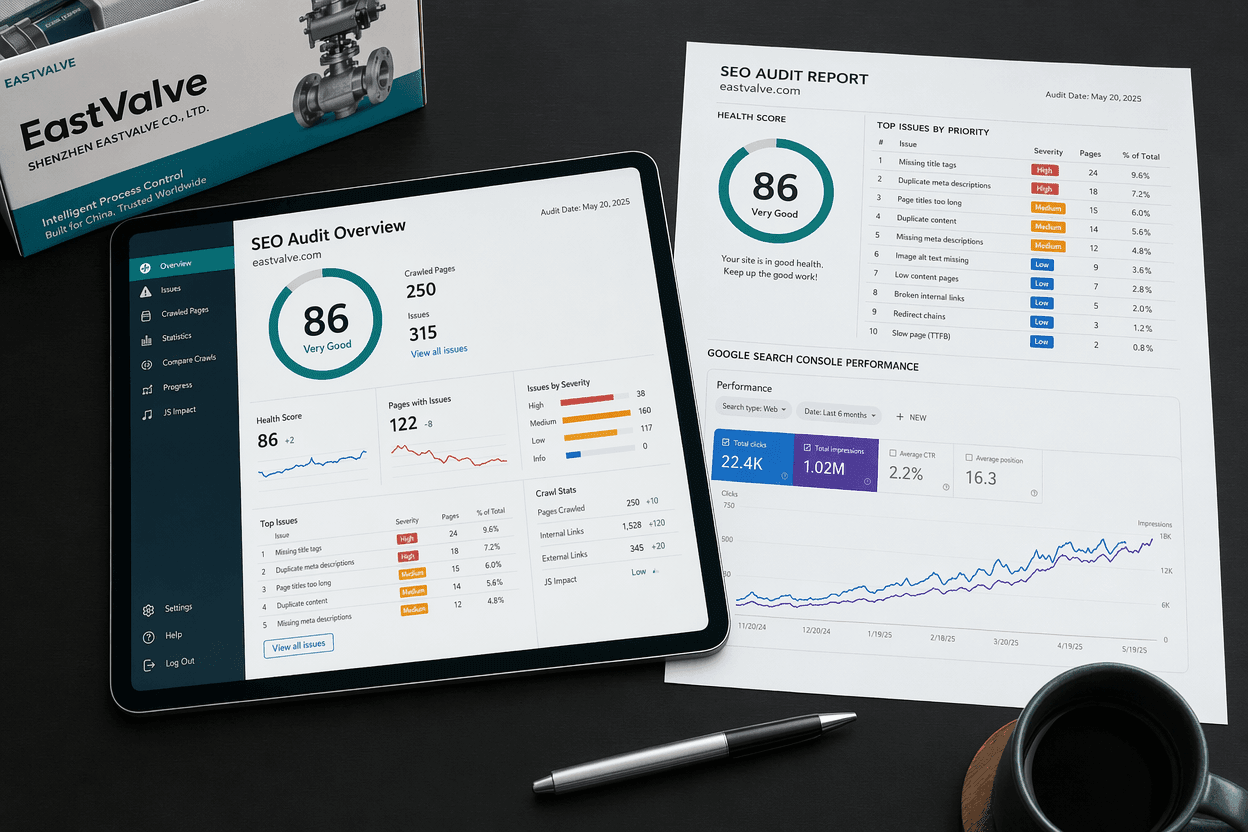
An SEO audit report showing a health score, a ranked list of issues, and a Google Search Console graph
One written report. Every issue ranked by impact.

Technical

Crawlability, indexing, and site structure. Core Web Vitals against Google’s thresholds, LCP under 2.5s, INP under 200ms, CLS under 0.1, measured from your buyer’s market, not from China.

Content

Titles, headings, meta, image tags, internal links. Whether the English reads native or machine-made. And whether the page answers what Western buyers actually type, judged against EEAT.

Authority

Your full backlink profile against where you want to rank. Top-three sites carry 100 to 250 referring domains, about 3.8x more than the rest, so we measure exactly how wide your gap is.

The technical layer feeds straight into Onsite SEO. The authority gap feeds the plan in Offsite SEO. And the AI-visibility check feeds GEO. The audit is the map the rest is built from.

How it runs

From access to a clear map.

23 weeks to the written report. One scoped project fee, quoted before you commit.
  1. Access

    You hand us the keys.

    Read access to the site, plus your Google Search Console and analytics. Nothing more. We start from what Google already sees, not from a guess.

  2. Audit

    We check it Google’s way.

    A full pass against Google’s current best practices, technical, content, and authority, updated as those practices shift. Every issue gets weighed by impact.

  3. Report

    You get the map.

    A written report in two to three weeks. Every problem ranked by impact, what to fix first, and roughly what each fix takes. No jargon, nothing padded.

Then watch the list shrink.

Every issue loads into your dashboard, ranked by impact. As fixes go live the list shrinks and your health score climbs, in the same dashboard your onsite, offsite, and GEO work reports into.

Book a call

Questions

Questions, answered plainly.

My site is already translated into English. Is that not enough for Google?

No, and this is the most common trap we see. A translated Chinese site is a home-market site in an English coat. The keywords are translated, not researched. The structure was built for Baidu’s crawler. And the trust signals Google looks for are not there. It reads correctly and still does not rank, because buyers never type the words it targets.

Why won’t my Baidu rankings carry over to Google?

Because the two engines reward opposite things. Baidu wants Simplified Chinese, .cn domains, links from Chinese sites, and servers inside China. Google wants original native English, links from trusted Western sites, fast hosting near your buyers, and a kind of trust the home-market engine never measured. Almost none of your Baidu work transfers.

What exactly do you check?

Three layers. Technical: crawlability, indexing, structure, and Core Web Vitals measured from the target market. Content: titles, headings, meta, image tags, internal links, whether the English is native, and whether it answers real buyer searches, all weighed against EEAT. Authority: your full backlink profile against the sites you want to outrank, so you see the exact size of the gap.

How long does the audit take, and what do you need to start?

Usually two to three weeks for the written report. To begin we need read access to the site and to your Google Search Console and analytics, nothing more. The report ranks every issue by impact, tells you what to fix first, and roughly what each fix takes.

Do I have to use you for the fixes?

No. The report is plain enough that your own developers can work the list. Or our team handles the fixes and the ongoing work across onsite, offsite, and GEO. Either way the audit is the map, and nothing else we do makes much sense without it.

How fast will I see results?

Be patient with the trust signals. EEAT is a slow build: most sites see real movement around the three-to-six-month mark, and some deeper authority signals take a year or more. We say this on the first call, because anyone promising faster is selling something.

What about AI search, ChatGPT and AI Overviews?

The audit looks at both worlds at once: classic rankings and AI visibility. AI Overviews now show on roughly a third of searches, and brands cited inside those answers see about 35% higher click-through than the rivals left out. The AI side is covered in detail on our GEO page.

What does it cost?

A fixed project fee that depends on the size of the site. We quote it on the call, before you commit to anything. No hourly meter, no surprise invoice.

Want to know what is holding your site back? Book a call and we will walk you through it.

The first move

Find what blocks you.

The audit is the map. Nothing else we do, onsite, offsite, or GEO, makes much sense without it.

We measure from your buyer’s market, not from China.

Book a call

Reviewed June 2026

Next module: Onsite SEO