








When your buyer is an AI agent, not a person
Western buyers now hand routine purchasing to AI agents that read data, not pitches. Machine-readable data decides which Chinese suppliers an agent will pick.
On this page
Your overseas buyer used to be a person. They read your page, weighed your pitch, and made a call. A good story and a fair price could win the deal.
That is starting to change. The buyer is becoming a machine.
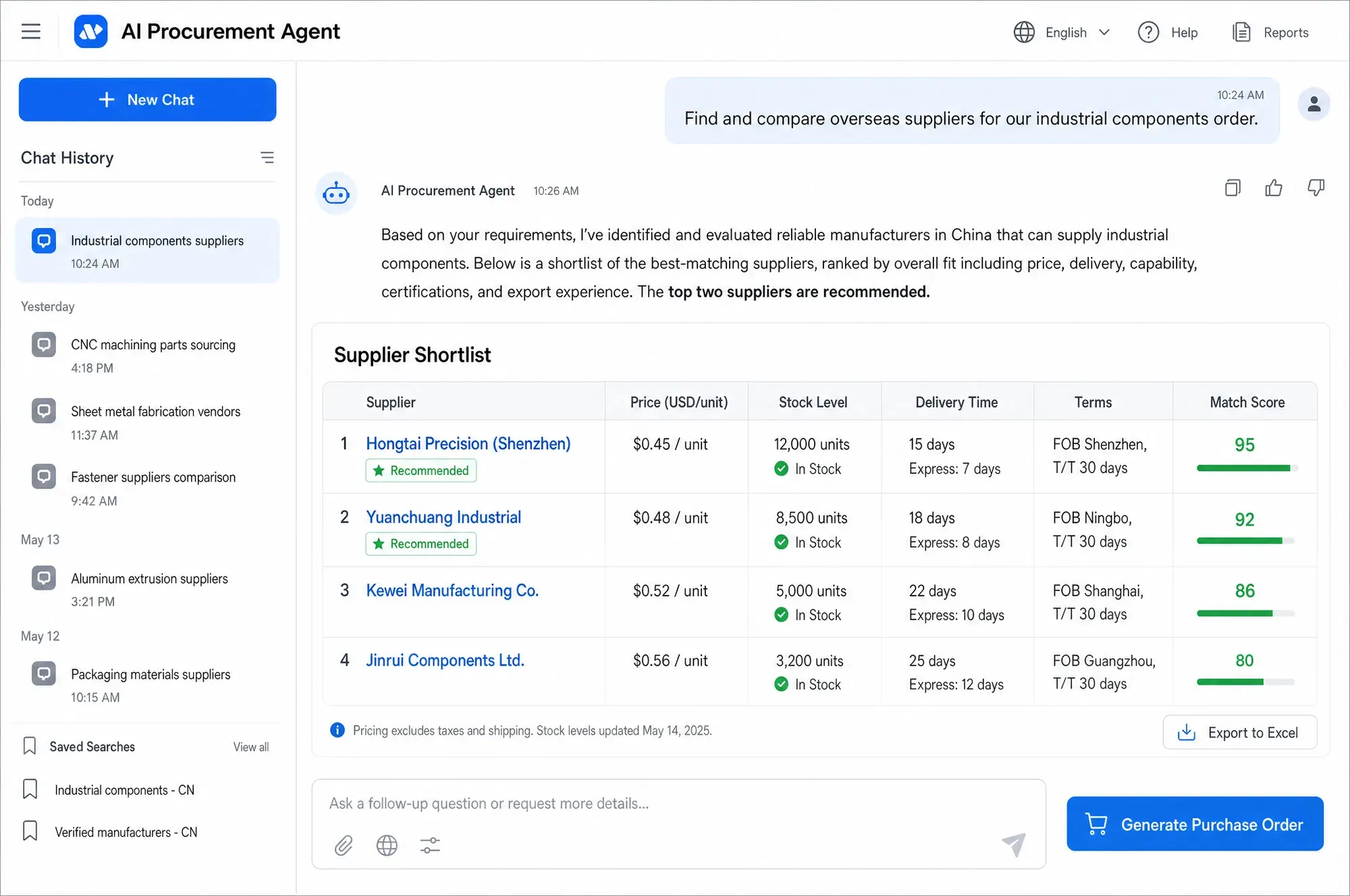
Large companies are handing routine purchasing to AI agents. The agent does not browse. It does not read your brochure. It queries your data and checks four things before it moves on: price, stock level, delivery time, terms. If your numbers are clean and current, you stay in the running. If they are buried in a PDF or an old sales email, you are out.
This is not a far-off forecast. Call it a two-year runway.
How big this actually is
Gartner’s headline prediction for 2026 says that by 2028, AI agents will handle 90% of business buying and move more than $15 trillion through automated exchanges. For scale, that is on the order of half of US GDP moving through machines that act for buyers. It is a forecast, not a fact. But you can see the direction from here.
The early signs are already here. Forrester expects that during 2026, 20% of sellers will face agent-led price negotiations, where a buyer’s agent asks for a quote and a seller’s agent replies. No email. No phone call. A deal can be won or lost in a data handshake.
The big platforms are already building it. SAP’s procurement suite runs an agent that compares bids on its own, weighing unit price against shipping and payment terms in seconds, work that used to cost a buyer days. The buyer’s agent talks to the seller’s agent, and the two settle inside rules each side has set. That is not a demo. It ships today.
And buyers want it. A March 2026 Gartner survey found 67% of business buyers now prefer to purchase with no sales rep involved at all. The human is quietly stepping out of the early deal.
AI agents do not browse. They query pricing, inventory, and delivery, and they expect every answer to be accurate in real time.
Why this puts Chinese companies at risk
Most Chinese companies sell overseas with their data locked in formats a machine cannot read. The price list is a PDF. Stock counts live in a spreadsheet that someone updates by hand every week. Specs are written into marketing copy instead of listed as plain facts.
A human buyer would email to ask the missing question. An agent will not bother. It takes the supplier whose data answers cleanly and skips the rest.
So the old edge starts to slip. You can run the best factory at the best price and still lose the order, because a machine could not read your terms. The buyer’s agent never sends a first message. You are out before anyone says hello.
The gap nobody is talking about
Here is the part most companies miss. Buyers are moving faster than sellers.
Deloitte Digital, in February 2026, put buyer-side AI adoption near 38%, with the seller side trailing at just 24%. Most suppliers are not ready. Plenty are stuck mid-way through long system upgrades, with nothing left over for this.
That gap is your opening. Buyers are already sending agents out to shop. Sellers who answer those agents cleanly are still rare. Get your data in order now and you turn up when an agent goes looking. Your competitors, meanwhile, stay invisible to it.
This is not about spending more. It is about being readable.
What to fix first
Start with what the agent checks. Make your price, stock, delivery time, and terms current and easy to pull. Get them out of PDFs and into clean, structured fields. Keep them accurate in real time, because an agent that hits an old price moves on.
Then close the gaps in your catalog. Agents skip suppliers with missing specs. Every blank field is one more reason to pick someone else, and they will. Google’s own shopping data shows stores with near-complete product attributes earn three to four times the visibility in AI recommendations versus stores with thin data. Full catalogs win far more often.
There is an upside here too, not only a threat. The supplier an agent can read cleanly gets a faster yes. No back-and-forth, no chasing a spec sheet, no waiting on a quote. Readable data is not only defense. It shortens the path to the order.
None of this replaces the human side. When a person finally enters the deal, late and already half decided, your brand and your proof still have to hold up. But the machine decides whether that person ever sees you in the first place.
The companies that win overseas two years from now will not be the loudest. They will be the ones a machine can read without friction and trust enough to choose. The work is dull, and it is not optional, and the two-year head start goes to whoever moves first.
Not sure what an agent sees when it goes looking for a supplier like you? That is the place to start. Book a call.
Be the answer
Want to be in that answer when your buyer asks?
One team, from brand to a named rep who answers the call, building the proof AI repeats and buyers trust.