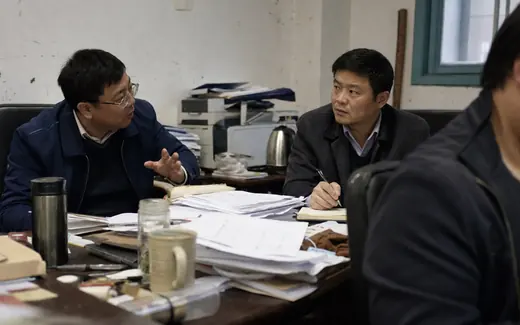
The platform gets the order, not the buyer
The platforms bring orders, but every one keeps you a supplier behind someone else's brand. Where they stop, and what reaching the Western buyer takes.
On this page
The orders are real. The buyer relationship is not. A look at where the Chinese B2B platforms stop in 2026, and the slower work that gets you past them.
Your factory is busy. Orders come in through Alibaba International, or a trader on 1688. The numbers look fine.
Then look at what the buyer on the other end sees. Not your company. A supplier. One row of forty on a results page, sorted by price.
China’s export e-commerce moved 2.75 trillion yuan in 2025, according to China Customs. Plenty of that runs through the platforms you already know. In 2026 two things made the trade sharper. The platforms got smarter about matching buyers to factories. And the cheap-parcel model that carried so much of this volume started to break. Both matter. Neither one fixes the real problem, which is that the platform owns your buyer and you do not.
The platforms got smarter
Alibaba.com International Station (阿里巴巴国际站) still moves around $50 billion in goods a year, its president told the 21st Century Business Herald. In late 2024 it launched Accio, an AI agent that shops on the buyer’s behalf. By its CoCreate event in September 2025 the tool had passed 2 million overseas business users, and it now fields roughly 5 million queries a day.
Your side changes too. The buyer no longer types two keywords. They type the whole job in plain English, a full paragraph of specs, and the AI breaks it into parts and ranks the factories that fit. It can even handle the first exchange. Alibaba tells the story of a Yiwu seller who landed a $20 million order from a Saudi buyer while he was offline, because the platform’s bot answered first, not him.
On Alibaba’s buyer-facing AI, a Western buyer now writes the full request in plain language, down to the line “supplier preferably has done brand OEM.” The system reads it and ranks the factories that match.
Read that buyer’s line again. They are asking for a factory that already builds other companies’ products. The platform sits you in that seat. A busy seat, and a paying one. Still a back seat.
The rules got harder
For years a lot of this ran on one rule. Packages under $800 entered the United States duty-free. In fiscal 2024 about 1.36 billion parcels used it, most of them from China, per US Customs.
That rule ended for China on May 2, 2025. Temu stopped shipping straight from China to American shoppers within days and rebuilt around US warehouses. By late 2025, close to 90% of its US and European orders shipped from local stock, Huxiu reported. Even the platform that made cheap direct mail famous had to move the goods onshore.
This runs past the United States. The European Union plans to scrap its own low-value exemption in 2026 and add a fee on every parcel. China has tightened export reporting, so goods can no longer slip through under a borrowed customs name. Both ends of the route check the paperwork now.
The low-price, ship-from-China game is getting taxed and squeezed. What sells now is a branded product that sits in the buyer’s market and competes on more than price. That shift runs straight through the platforms you sell on. The company with a name gets the buyer. The factory with the low quote gets a purchase order, and a fresh quote to beat next quarter.
The DHgate moment
In April 2025, DHgate (敦煌网), a twenty-year-old B2B site, shot to number two on the US App Store, behind only ChatGPT. US downloads jumped more than 900% in a week, per Sensor Tower. The spark was TikTok. Chinese suppliers posted videos showing that bags and clothes sold as Western brands came out of the same Chinese factories, then linked straight to DHgate.
For a moment the whole world saw the supply chain. And what did the Western buyer take away? That the Chinese factory is the cheap version of a real brand. Business Insider called DHgate a dupe platform, and the label stuck. To hold prices that low, some sellers blur the brand marks and ship white-label copies, which invites account bans and legal trouble. The point holds either way. On that platform you are the maker nobody names.
Millions of buyers looked straight at Chinese manufacturing, and the story they kept was “same product, one-third the price.” Not a brand they would remember, just a discount to squeeze. The platform handed you attention and spent it making you interchangeable.
The same ceiling, everywhere
You might think your platform is the exception. Line them up, and each one does a job well and stops at the same wall.
| Platform | What it gets you | Where it stops |
|---|---|---|
| Alibaba International Station | Steady inquiries and AI matching | The buyer meets a listing, never your brand |
| Made-in-China.com | A verified factory profile | The buyer keeps ten profiles like yours open |
| 1688.com | Factory-gate prices | A trader resells your goods; the buyer never learns your name |
| Temu / Pinduoduo (拼多多) | Volume and fast local delivery | The platform sets your price and keeps the customer list |
| DHgate (敦煌网) | Small orders and quick reach | The buyer sees a cheaper version of a brand |
| Global Sources / HKTDC | Trade-show leads | The relationship resets when the fair ends |
The pattern is one line. On every platform the buyer’s relationship is with the platform, not with you. You are a row that can be swapped for a cheaper row tomorrow. You never learn who the buyer is. You cannot follow up. You cannot hold your price either. The next listing is right there.
Past the platform
None of this means leave the platforms. Orders are orders. It means stop expecting them to do the one thing they are built not to do, which is hand you the buyer.
We grow Chinese brands overseas, and the pattern repeats with almost every factory we take on. The orders were rarely the problem. The buyer relationship was.
The companies pulling ahead in 2026 do the slower work beside the platform. They build a brand a Western buyer recognizes, and a site the AI names when a buyer asks. Then they put a real person in the buyer’s market and time zone, someone who picks up when the inquiry lands at 3 a.m. back home.
That work does not replace the platform. It sits on top of it, and it turns a stream of price-shoppers into a handful of buyers who came looking for you.
This is a different motion from listing a product and waiting. It is how you stop being the interchangeable factory and start being the company a buyer asks for by name.
Not sure what a Western buyer sees when they look for a supplier like you? That is the place to start. Book a call.
Be the answer
Want to be in that answer when your buyer asks?
One team, from brand to a named rep who answers the call, building the proof AI repeats and buyers trust.