







What Chinese exporters should post on LinkedIn
Your company page posts news and nobody answers. What Western buyers stop for, who on your team should write it, and how often to post.
On this page
Look at your company page. If the last twenty posts are trade show photos and product launches, you already know why the page is quiet. Nobody outside your company has a reason to read it.
We wrote before about the 2026 algorithm change. Every post now clears three gates before a buyer sees it: a spam filter, a small test group, then the wide push. That article covers the machine. This one covers what you put in the box, which is the half you control.
Most exporter content dies at gate one, the spam filter, for a simple reason. It reads like a brochure.
The mix, at a glance
| Type | Share | Out of ten posts | What it does |
|---|---|---|---|
| Teaching | About 40% | Four | Earns saves and comments. Opens reach to new buyers. |
| Perspective | About 30% | Three | Builds trust. Makes you a person, not a supplier. |
| Promotion | 10 to 20% | One or two | Asks for the order. Works only when the rest is there. |
Treat these as a starting ratio, not a rule. Run it for eight weeks and let your own analytics correct it.
The three types, with examples that fit a factory
These categories sound abstract on a slide. Here they are on a factory floor.
Teaching content, about 40%
Teaching is the engine. It earns the saves and the real comments, and those are what tell LinkedIn to push you wider.
Most exporters think they have nothing to teach. You have more than almost anyone in your buyer's feed. You just don't think of it as content, because to you it's Tuesday. We have sat in enough factory meetings to know the reflex: the good material gets waved off as too obvious to post.
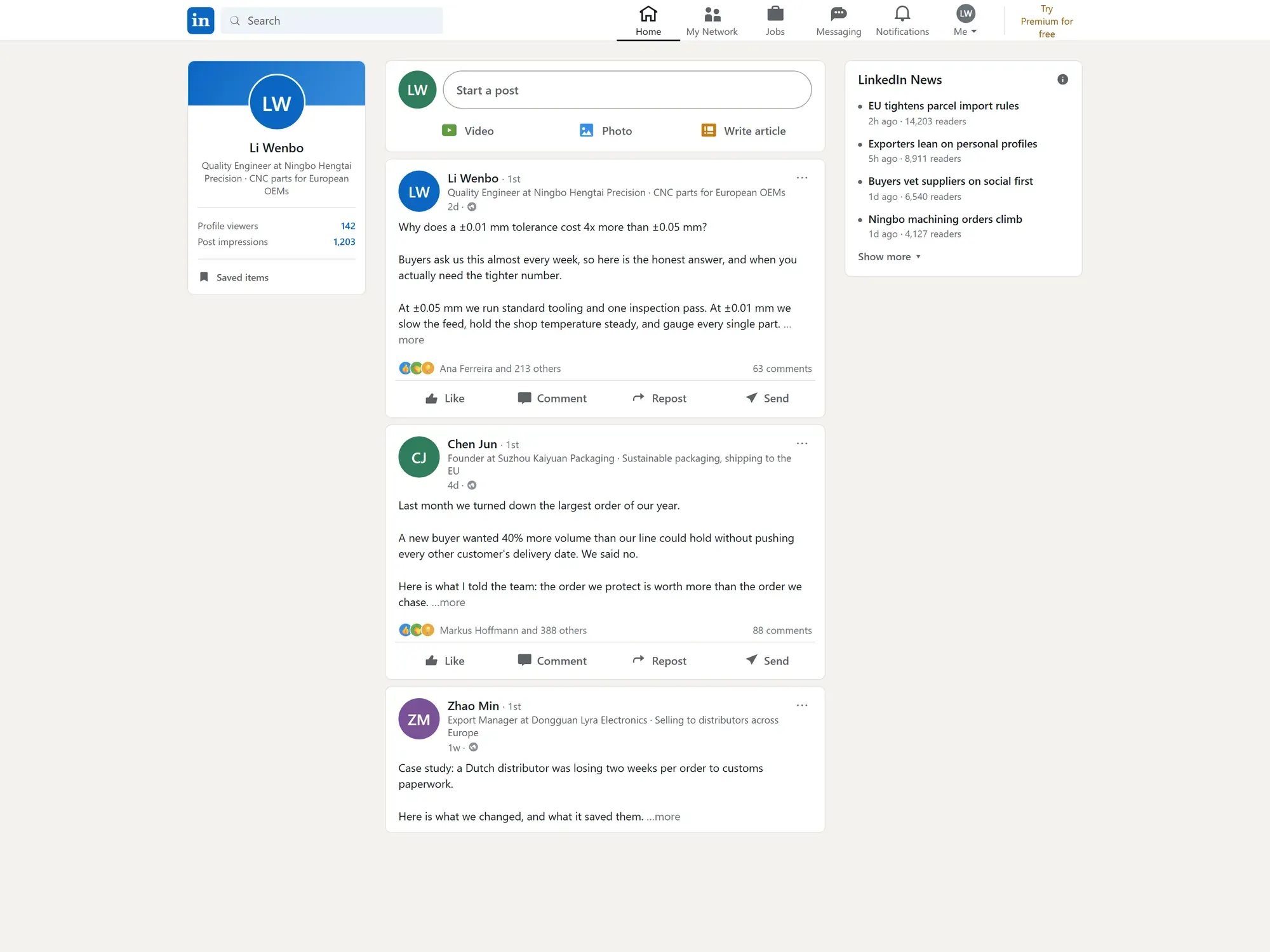
A CNC parts supplier posts a breakdown of why a tolerance of ±0.01mm costs four times more than ±0.05mm, and when the buyer actually needs it. A packaging factory posts what changed in EU recycling rules this year and which materials now fail. A battery maker posts the three questions to ask any supplier about UN38.3, the transport safety standard. A logistics company posts what actually happens during a customs hold, and what the paperwork should have said.
None of these mention the company's products. They are useful whether or not the reader ever buys from you. Which is exactly why they work.
Now here is the part that pays. A German procurement manager saves the tolerance post because he needs it Thursday. He does not contact you. Nobody does, not that week. Then months later his supplier misses a tolerance on a production run and he needs a second source fast. He does not open Google. He opens his saved items, because he remembers reading something sensible about exactly this, and your name is on it.
The whole thing runs slower than anyone selling LinkedIn services likes to admit. You are not generating a lead. You are making sure your name is in the room when the problem shows up.
Perspective content, about 30%
Buyers trust people. They do not trust logos. This is the category that turns a page people follow into a page people read.
Perspective does not mean personal drama. In B2B it means a real point of view, from a person with a name and a face.
Your quality engineer writes about the batch you rejected last year, what it cost you, and what came off the line differently afterward. Your export manager writes about the customer who specified the wrong steel grade, and the three questions they now ask before quoting. Your founder writes about turning down a large order that would have wrecked the delivery schedule for everyone else.
That last one is the strongest post most exporters never write. A Western buyer learns what no certificate can tell them: what you do when things go wrong. It is the real question behind every supplier audit.
Promotional content, 10 to 20%
You are on LinkedIn to sell. Anyone telling you never to promote has not had to hit a quota.
But look at how most exporter promotion is actually built. A photo of the product, a list of specs, a line about competitive price and reliable quality, contact us for a quote. That says nothing a hundred other suppliers are not saying the same week.
A case study works when it names the buyer’s problem, not your capability. A Dutch distributor was losing two weeks per order to customs paperwork. Here is what we changed, here is what it saved, here is who did it. That reads as evidence.
The same case study from an account that only talks about itself reads as noise. Promotion works when it's surrounded by proof.
Who on your team should actually be posting
Say you accept all of that and you have the mix right. There is still one question left, and for Chinese companies it is the one that decides whether any of this happens at all.
Start with the surface. The company page has been losing ground for two years. Personal profiles now carry far more reach, and the gap is not small.
Only about 3 percent of employees share content about their employer. Those shares generate roughly 30 percent of the company's total engagement.
Three percent of the people, thirty percent of the result. Whatever your company page is doing, a handful of named employees would out-reach it.
You will see bigger numbers quoted elsewhere. Five times the engagement, 561 percent more reach, and so on. Those trace back to one vendor study, re-cited until it looks like consensus, so keep them out of your budget deck. The direction holds regardless. LinkedIn built the feed around people talking to people, and a company page is a brand talking at a crowd.
Chinese trade media has reached the same conclusion from the other direction. Guides written for foreign trade teams in 2026 now tell readers that personal posts spread faster than company announcements, and recommend two industry insight posts a week from a personal profile. The advice converged because the mechanism is real.
Which lands you on the real problem. The expertise sits with your engineers and your export team. Many of them do not write English well enough to post in it. Some have no profile at all. And a founder who writes beautifully in Chinese can sound stiff in English translation, which reads to a Western buyer as distance, or worse, as someone hiding.
So who writes it?
Not the engineer, in English. Ask a quality engineer to draft posts in a second language and you will get four of them and then silence. What survives contact with a real factory is narrower: the engineer talks, someone else writes.
Twenty minutes on a call, in Chinese, about the batch he rejected. That is one post. Once a month gives you twelve a year in his name, with his face on them, carrying judgment he never had to translate. The words were never the expertise.
The company page still has a job. It's your credibility check, the place a buyer lands when they want to see your certifications and your factory. Keep it current. Just stop expecting it to bring you anyone. The reach has to come from named humans.
Three posts a week beats thirty
Once you know who is talking, the volume question answers itself.
One post that teaches, one with a point of view, one closer to the ask. Add a fourth when something real happens.
The failure we watch most often is a manager telling the team to post something, anything, just to keep the account alive. LinkedIn reads low-effort content and holds your reach down for it. Posting badly is worse than not posting at all.
Only about one percent of LinkedIn users post anything in a given week. The bar is on the floor. Clear it and you are ahead of nearly everyone in your buyer's feed.
Start with an audit, not a calendar
Go back through your last twenty posts. Label each one: teaching, perspective, or promotion. Then count.
If sixteen of twenty are promotion, you do not have a LinkedIn problem. You have a content problem, and now you know exactly which one.
The audit is free and takes an hour. The part that costs you is everything after it: pulling an engineer's judgment out in Chinese and landing it in English a buyer trusts, week after week, without it sounding translated.
Book a call. We will show you what your LinkedIn presence could look like in your target market.
Be the answer
Want to be in that answer when your buyer asks?
One team, from brand to a named rep who answers the call, building the proof AI repeats and buyers trust.